


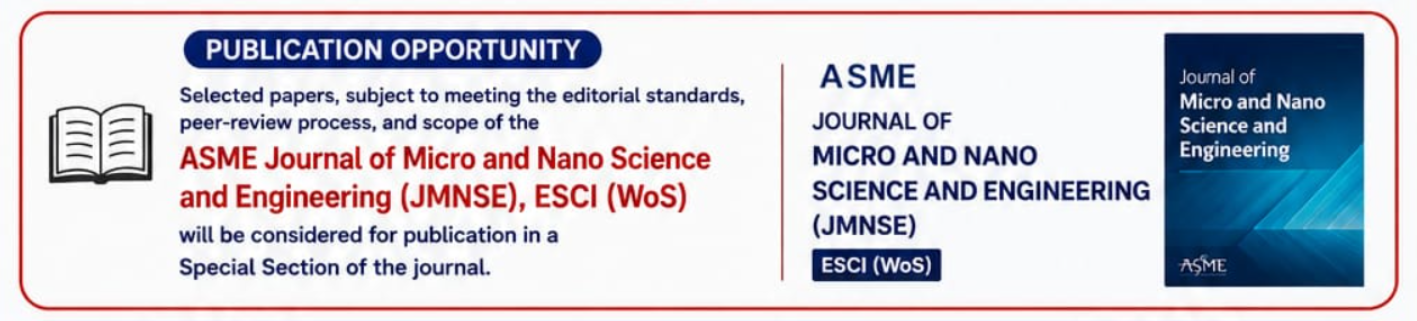
📚 Accepted papers will be considered for publication in a reputed Scopus-indexed Book Series and/or Journal, subject to the scope, quality requirements, and review policies of the respective publication partners. 📚 Accepted papers will be considered for publication in a reputed Scopus-indexed Book Series and/or Journal, subject to the scope, quality requirements, and review policies of the respective publication partners. 📚 Accepted papers will be considered for publication in a reputed Scopus-indexed Book Series and/or Journal, subject to the scope, quality requirements, and review policies of the respective publication partners. 📚 Accepted papers will be considered for publication in a reputed Scopus-indexed Book Series and/or Journal, subject to the scope, quality requirements, and review policies of the respective publication partners.
ADBU Logo CGU Logo GU Logo Assam Skill University Logo

Originality of Submitted Papers

Papers submitted to the Research Conclave 2026 must contain original, previously unpublished research work by the author(s) that is not currently under consideration for publication elsewhere.

⚠️ Plagiarism Policy: Standard plagiarism check guidelines apply to all submissions. The author(s) are solely responsible for ensuring the academic integrity of their submitted work.

1. Manuscript Preparation

Prepare manuscripts using the official Research Conclave 2026 Springer Proceedings Template. Papers must be written in clear English and follow the prescribed template.

2. Paper Length

Regular papers should be 8–10 pages. The maximum length is 12 pages including references unless otherwise notified.

3. Paper Structure

Include: Title, Authors, Affiliations, Corresponding Author Email, Abstract (150–250 words), 4–6 Keywords, Introduction, Related Work, Methodology, Results and Discussion, Conclusion, Acknowledgement (if applicable), and References.

4. Formatting Requirements

Use A4 paper, Times New Roman font, SI units, numbered figures/tables, and the styles provided in the template.

5. Figures and Tables

Use high-quality figures (300 dpi or higher). Caption figures below and tables above. Cite every figure and table in the text.

6. Equations

Create equations using Microsoft Equation Editor or MathType. Number equations consecutively and define symbols at first use.

7. References

Follow Springer reference style. Ensure every citation appears in the reference list and every reference is cited in the manuscript.

8. Originality and Plagiarism

Submitted work must be original, unpublished, and not under consideration elsewhere. All accepted papers may undergo plagiarism screening.

9. AI Tools

AI tools may be used for language improvement only. Authors remain fully responsible for the content and AI systems must not be listed as authors.

10. Submission Procedure

Before submission, verify that the paper follows the template, author information is correct, references are complete, and the manuscript has been proofread. Submit PDF (and editable source files if requested).

11. Review Process

Submissions will be peer reviewed based on originality, technical quality, novelty, relevance, and clarity. Decisions include Accept, Minor Revision, Major Revision, or Reject.

12. Camera-Ready Submission

Accepted authors must revise their papers according to reviewer comments, submit the final manuscript, complete copyright/licensing requirements if applicable, and register before the deadline.

13. Presentation

At least one registered author must present the accepted paper during the conference.
Paper Template Structure

Follow this structure when preparing your manuscript

RESEARCH CONCLAVE 2026

Advancing Semiconductor Design, Assembly, Testing, and Packaging in Southeast Asia

Springer Proceedings Paper Template (Author Version)

Paper Title

First Author1, Second Author2, Third Author1

1 Department, Institution, City, Country
2 Department, Institution, City, Country
Corresponding author: author@email.com

Abstract

Write a concise abstract of 150–250 words summarizing the objectives, methodology, key results, and conclusions.

Keywords

Keyword 1; Keyword 2; Keyword 3; Keyword 4; Keyword 5

1 Introduction

Replace this text with your content.

2 Related Work

Replace this text with your content.

3 Methodology

Replace this text with your content.

4 Results and Discussion

Replace this text with your content.

5 Conclusion

Replace this text with your content.

Acknowledgements

Replace this text with your content.

References

[1] Author(s), "Title," Journal/Conference, vol., no., pp., year.

[2] Author(s), Book Title, Publisher, year.

Important Notes

  • Once a paper is submitted, it enters the review pipeline immediately. Under no circumstances can papers be updated or resubmitted during the review phase.
  • The introduction section of your paper should clearly emphasize the unique contributions of your work and reference relevant previous publications.
  • All oral presentations during technical sessions must be conducted in English.

Peer-Review Management

The Microsoft CMT service is used for managing the peer-reviewing process for this conference. This service is provided for free by Microsoft and they bore all expenses, including costs for Azure cloud services as well as for software development and support.

📄

Submit Your Paper

Ready to submit? Click the button below to access the official paper submission form for Research Conclave 2026.

🚀 Submit Paper Now

You will be redirected to the official event portal for submission.

Contact Us

For queries related to registration, papers, or travel assistance

🇮🇳 India Organising Committee

Dr. Mriganka Gogoi Convener
Dr. Karen Das Co-Convener
Dr. Samarjyoti Saikia Co-Convener
Dr. Sanjib Kalita Co-Convener

🇹🇼 Taiwan Organising Committee

Dr. Abdul Shabbir Convener
Dr. Debraj Banerjee Co-Convener

Department of Electronics and Communication Engineering
Assam Don Bosco University, Azara Campus, Guwahati, Assam, India